
Self and wellbeing
Quest Alliance · Education · Social impact
One curriculum.
Two ways into it.
A shared visual learning system for young people exploring identity, gender, puberty and personal growth—and for the adults guiding them.
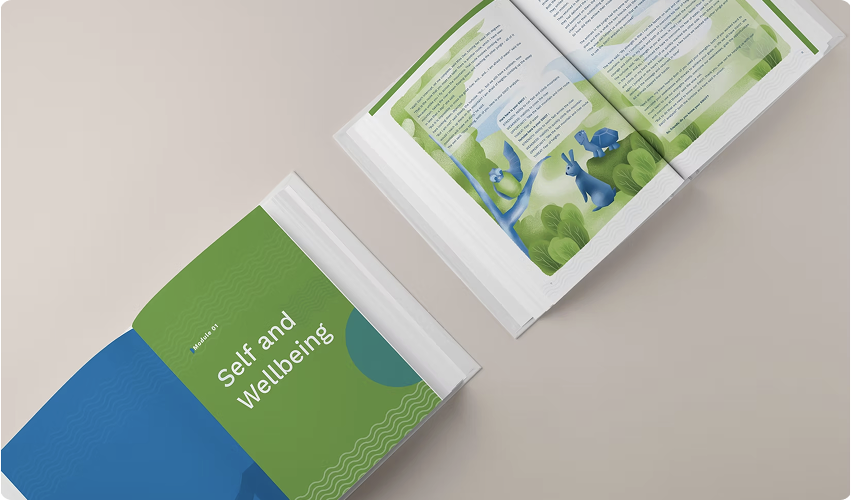
2 booksdesigned as one connected system
2 audiencesstudents and facilitators
4 moduleseach with a distinct identity
Classes 8–9the intended student audience
01 · Context
Sensitive subjects need an inviting format
The curriculum covered gender stereotypes, puberty, self-awareness and practical learning skills. It needed to be engaging and age-appropriate without reducing the seriousness of the content. At the same time, the student workbook and facilitator manual had to feel related while supporting very different ways of reading and using information.
02 · System challenge
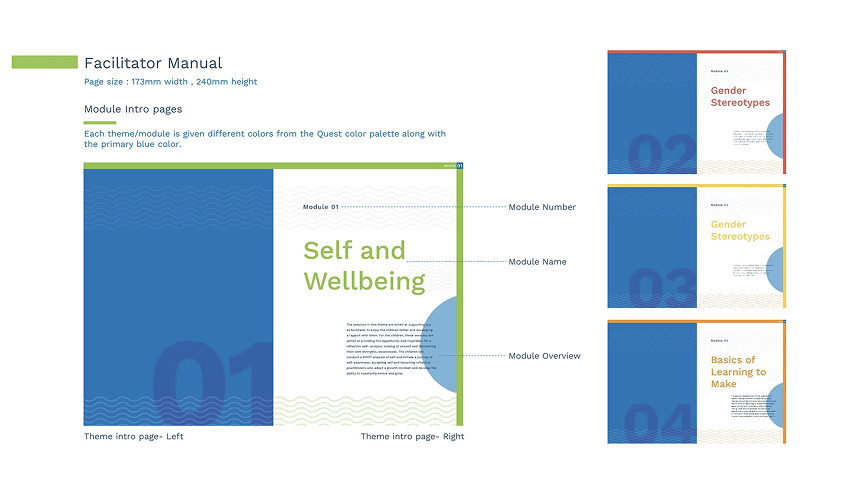
Give every module a voice without losing the family
The documents combined stories, drawing activities, flowcharts, session plans and illustrated instructions. A rigid template would not accommodate that variety; an overly flexible one would make the curriculum feel fragmented.
Module identity
Module identity
Basics of learning to make
03 · Student workbook
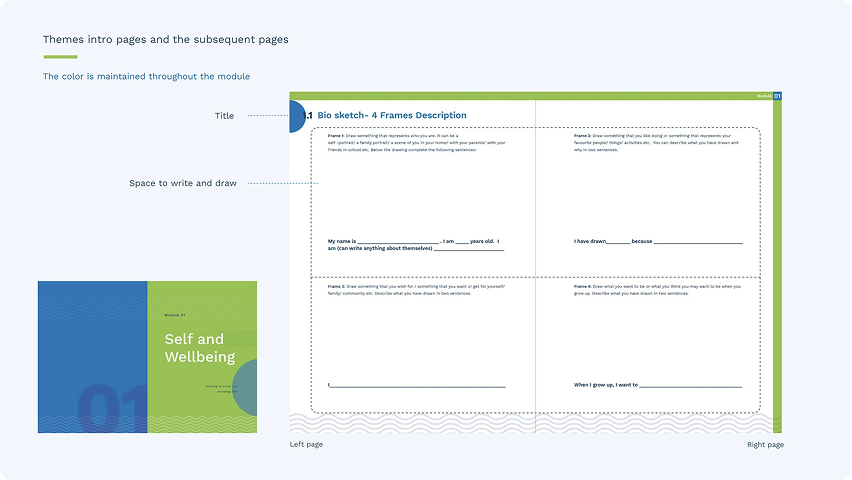
Pages that make participation feel manageable
The workbook was made for direct interaction. Module introductions provide clear orientation, while activity pages use generous writing and drawing spaces with minimal instruction so that the page does not feel intimidating.
04 · Facilitator manual
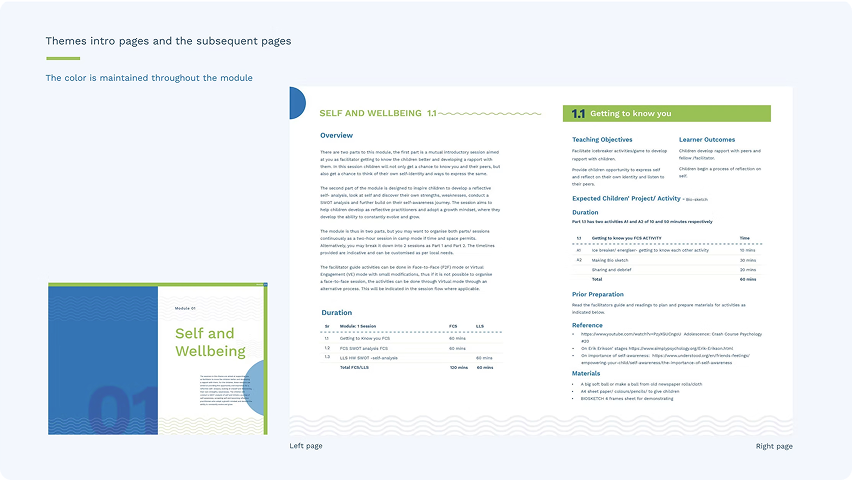
The same system, built for denser decisions
The facilitator manual carries the workbook’s colour and module structure into pages containing teaching objectives, learner outcomes, timings and step-by-step activities. Corresponding pages remain recognisable when the two books are used side by side.
Student-facing
Space to respond
Short prompts, writing lines and open frames foreground participation.
Facilitator-facing
Structure to guide
Session information is organised for preparation and use during delivery.
05 · Illustration direction
Storytelling that also teaches sequence
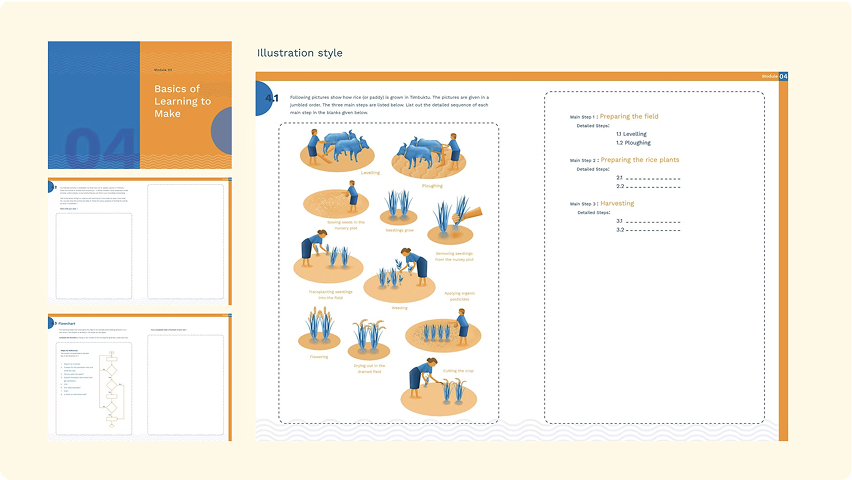
Flat figures, expressive postures and sandy neutral tones made the story-based material approachable without tying it to a narrowly defined identity. In the rice-farming activity, illustration also became functional: each scene had to communicate an action clearly enough for students to reason about its order.
06 · My contribution
Owning the system from structure to expression
Design leadership
- Built the shared visual system for two companion documents
- Defined the colour-coded module structure
- Designed layouts for varied educational content
- Led the figurative illustration direction
Collaboration
- Worked closely with Quest Alliance’s content team
- Balanced sensitive subject matter with an accessible tone
- Adapted one system to student and facilitator needs
- Owned the work as an independent freelance lead
Reflection
“The four-module constraint pushed me to establish the system early. The next step would be testing the most content-heavy facilitator pages even earlier.”